
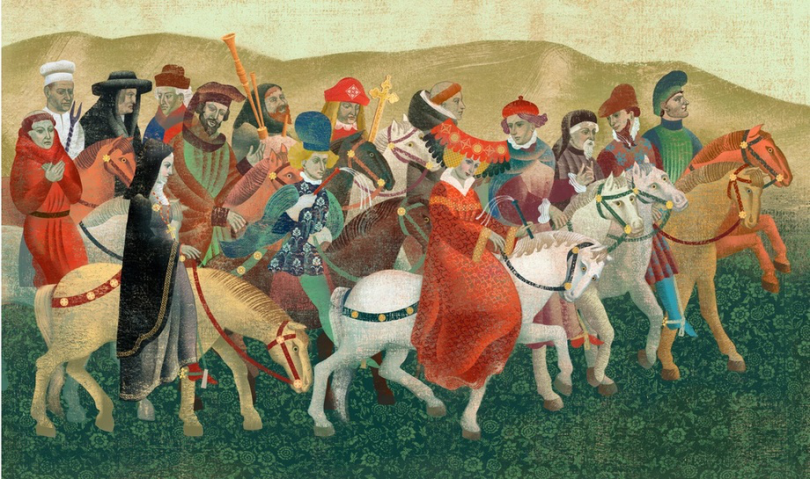
Something that really interested me from Professor Lay’s lecture on October 4th, 2017, titled “Narrative Transgressions and Chaucer’s Man of Law Tale” was the fact that Chaucer read many books about travel and drew from multiple sources to write his tales. Did Chaucer use these other works that were being popular at the time to get inspiration for the characters he included on the pilgrimage?
After doing a bit of research and also talking in my discussion sections, I have learned that Chaucer had often traveled to Italy, France, and Spain where he encountered other writings and works. There is a very high chance that he was inspired to write his tales by Giovanni Boccaccio’s The Decameron. In this work, a group of individuals hiding outside of Florence in a villa to escape the Black Death each tell a story per night in order to pass the time, making it a frame story. The Canterbury Tales is an extremely similar work, with the story following a group of individuals on a pilgrimage, each telling 2 tales on the way to and from Canterbury. Other works by Boccaccio, including Il Teseida which it is said that the Knight’s Tale is based off of,were also influences for Chaucer.
It can also be assumed that Chaucer read and was a fan of the works of Francesco Petrarch, a Renaissance scholar and poet. In the Clerk’s Tale, Chaucer writes,”‘His name was Francis Petrarch, laureate Poet, whose most eloquent rhetoric Illumined Italy with poetry” (Chaucer 209-210). Chaucer used Petrarch’s work titled Grisilde as an inspiration for the Clerk’s Tale, with the Clerk even stating that he has learned the tale he is about to tell from the late Petrarch himself.

Another work that Chaucer was inspired by was the French poem Le Roman de la Rose written by Guillaume de Lorris and Jean de Meun. Chaucer used this work in many of his own but especially in the General Prologue and Prologue of the Wife of Bath’s Tale. The poem follows a young man who attempts to make his way through the castle to a ‘rosebud,’ which has many interpretations throughout the work, that he desires. The original Wife of Bath, La Vielle, appears in this work and Chaucer borrowed many of her characteristics, such as her overt sexuality and domineering personality, to create his own character. The Wife of Bath even restates some of La Vielle’s lines before she tells her tale. Chaucer writes, “‘Now listen how I managed things so well, You wives that have the wit to understand! Here’s how to talk and keep the upper hand” (Chaucer 155). These lines, as well as many that follow, discuss ways that women can deceive their husbands. These were taken from a direct translation of La Roman de la Rose.
Chaucer, like those around him, was clearly inspired by the wonderful works being created by the other writers of his time as well as the current events of his life such as the corruption of the Church. Although The Canterbury Tales is hundreds of years old, the story remains timeless and can still be related to society today.
Works Cited and Referenced
Chaucer, Geoffrey, et al. The Canterbury Tales. Oxford University Press, 2011.
Gardham, Julie, and David Weston. “The World of Chaucer: Medieval Books and Manuscripts.” The University of Glasgow Special Collections, special.lib.gla.ac.uk/exhibns/chaucer/influences.html.
“The Wife of Bath and Excerpts from Le Roman De La Rose.” Carson-Newman University, web.cn.edu/kwheeler/documents/Le%20Roman%20de%20La%20Rose.pdf.
 Tori's Treasure Trove

The argument presented is very interesting and unique. The way other texts are brought in demonstrate how Chaucer was greatly influenced in his writing. The evidence and clear hard work to find these texts is memorable to the reader. The only thing I would say would improve this post is expanding on the last paragraph. Why are Chaucer’s inspirations so important and what connections can we draw between his assimilation of stories and the assimilation of the characters? I am going to use your presentation of research in my next post because it creates a lot of interest.
LikeLike
This is a very thoughtful and insightful blog post! I really like how you developed your ideas and brought historical context into your analysis. Your argument is “Something that really interested me from Professor Lay’s lecture on October 4th, 2017, titled ‘Narrative Transgressions and Chaucer’s Man of Law Tale’ was the fact that Chaucer read many books about travel and drew from multiple sources to write his tales.” Your picture was memorable because it gave insight into your evidence that you provided in the article. I like how you related Chaucer’s time period to his writing influences, showing where his ideas perhaps came from. Your logic starts to get diluted in the closing paragraph. I think that you could have a better flow of ideas to summarize the points you made. Perhaps consider asking a question to further the knowledge of the reader or have a compelling closing line. I am going to use more historical background in my future blogs because of how well you did this. Thank you so much for writing such a great blog!
LikeLike
The main purpose of this blog post was to consider whether or not Chaucer used popular literature at the time to find inspiration in creating his characters for the pilgrimage to Canterbury. This serves as an in depth consideration of the source material of an incredibly old text where the consideration may not otherwise be had. This sort of thinking is considerably different to how I typically approach writing, but it created a very intriguing conversation throughout. Perhaps in the future, adding more interpretation of the quotes used instead of only providing where they originated would hold attention easier, but I certainly intend to find more about sources to the texts we read as we progress in the semester.
LikeLike
I think your argument made was about Chaucer using literature during his own time, and how his life experiences influenced the way he is as a writer, and what he writes about. I liked how in the first paragraph you put your main idea into one question that also made me think about the influence other old texts had on Chaucer. What was memorable for me was how you used quotes from different old texts, but I found that you could have analyzed these quotations better because I wanted to hear more about what was significant about the quotes you pulled from the various texts. From this blog post, I really loved the way you organized ideas, so that is something I will incorporate into my own writing. Your paragraph organization made sense to me, which is something I’d like to have in my own blog posts.
LikeLike
This is a very intriguing blog post. This definitely raises concerns as of what sources Chaucer takes to write the Canterbury Tales through his travels during the medieval age. What is memorable is that she mentions how Chaucer was clearly inspired by many creative works during that age, however, why is Chaucer significant in his works if he used the ideas and works of others during that certain time period? One of his goals in writing the Canterbury Tales is to propose a secular text that describes the mood of people during the aftermath of the Black Death. If this was the situation, would the other works he took from also involved in the Black Death?
LikeLike
I think your argument that Chaucer pulled from other works of his time for inspiration is very compelling, and after reading your blogpost, I absolutely agree. It is extremely interesting how he may have used works from all over Europe, showing just how cultured and open-minded of an individual he was. It also shows how ideas are able to transcend geographical borders. On a different note, I think your blogpost is incredibly well-written, and it is clear that you conducted much research, as you provided three examples of works and scholars that he may have borrowed from. Your use of language is very formal and clear, greatly helping convey your message.
LikeLike
I noticed how you gave a good background description on Chaucer’s upbringing and writing influences. I really enjoyed how you proved Chaucer’s writing inspirations and how you included in your blog post how he included them in the text. I also liked that you did additional research and found out more information about Chaucer’s travels during his lifetime. I think that you could have a better flow of ideas towards the end of the blog, perhaps with more analysis. Overall, it was an intriguing and great piece of work.
LikeLike
The argument presented, which is that Chaucer was inspired by many different writings and places, is unique and an interesting topic. I enjoyed the fact that he had many influences that were either directly referenced or obvious through correlation. If I ever decided to read the book again, I would remember Chaucer’s influences and connect the reading to said influences. The concluding paragraph claims that Chaucer was inspired by current events, as well as the corruption of the Church, but there isn’t any proof in the post that this is actually the case. I liked the amount of resources outside the reading that you provided, and I plan on using more in the future thanks to this post.
LikeLike
Your point that Chaucer drew from many different stories and his travels to create The Canterbury Tales was direct and I was able to easily grasp the concept. You use examples such as Giovanni Boccaccio’s The Decameron to show the similarities like the frame story that is used. Stating that Professor Lay’s lecture was on Chaucer’s Man of Law’s Tale made me want to know where Chaucer used his sources and influences for this tale. Also, you might have been able to add more analysis of the different texts you used to make a bigger impact. I enjoyed your use of examples, each one had a clear connection to the text and it didn’t feel forced. You answer your question at the beginning of the post and it carries throughout your writing.
LikeLike
I think your argument that Chaucer pulled from other works of his time for inspiration is very compelling, and after reading your blogpost, I absolutely agree. It is extremely memorable how he may have used works from all over Europe, such as Italy, France, and Spain, showing just how cultured and open-minded of an individual he was. It also shows how ideas are able to transcend geographical borders. On a different note, I think your blogpost is incredibly well-written, and it is clear that you conducted much research, as you provided three examples of works and scholars that he may have borrowed from. This does much in supporting your thesis. I will try to do more outside research in my blog posts as well. Your use of language is very formal and clear, greatly helping convey your message. However, I do feel that you could have added more onto your initial question (“Did Chaucer use these other works that were being popular at the time to get inspiration for the characters he included on the pilgrimage?”).
LikeLike